What is arc welding? Understanding types, processes, and more
A practical overview of arc welding methods — and where robots fit in each.
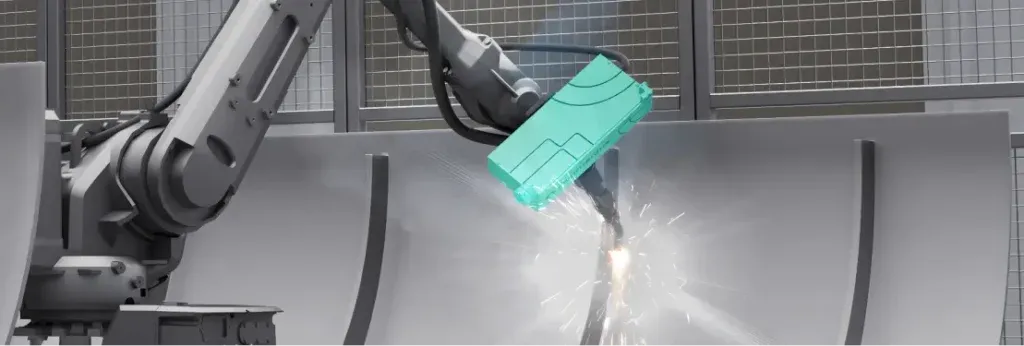
Arc welding has been the workhorse of metal joining for over a century. It uses an electric arc between an electrode and the workpiece to melt and fuse metal. The principle hasn't changed since the 1880s. What has changed — significantly — is how the process is controlled.
The four main arc welding methods
Four methods dominate industrial arc welding:
- Shielded metal arc welding (SMAW) — the classic "stick" welding. Cheap, portable, used heavily in construction.
- Gas metal arc welding (GMAW / MIG) — uses a continuously fed wire and shielding gas. Fast, clean, the most common method in factory welding.
- Gas tungsten arc welding (GTAW / TIG) — uses a non-consumable tungsten electrode. Slower but produces the cleanest welds; used for stainless, aluminium, and exotic alloys.
- Flux-cored arc welding (FCAW) — uses a hollow wire with flux inside. Strong in heavy-section steel and outdoor work.
Each one trades speed, quality, and cost differently. The choice depends on material, joint geometry, and downstream inspection requirements.
Where robots fit
All four methods can be automated, but they're not equally easy. MIG welding is the most-automated by far — high duty cycle, predictable arc, well-suited to robotic motion. TIG welding is harder to automate because it needs more precise positioning and slower travel speed. FCAW and SMAW are less commonly robotised, though heavy-section automation is gaining ground.
The newest layer is vision-guided robotic welding, which adapts the welding path to the actual joint geometry rather than relying on precise fixturing. Augmentus' platform supports MIG, TIG, and FCAW with scan-to-weld path generation.