Programming thermal-spray robots: teach pendant vs OLP vs Augmentus
Three approaches to thermal-spray programming, compared on the metrics that matter — coverage, consistency, and onboarding time.
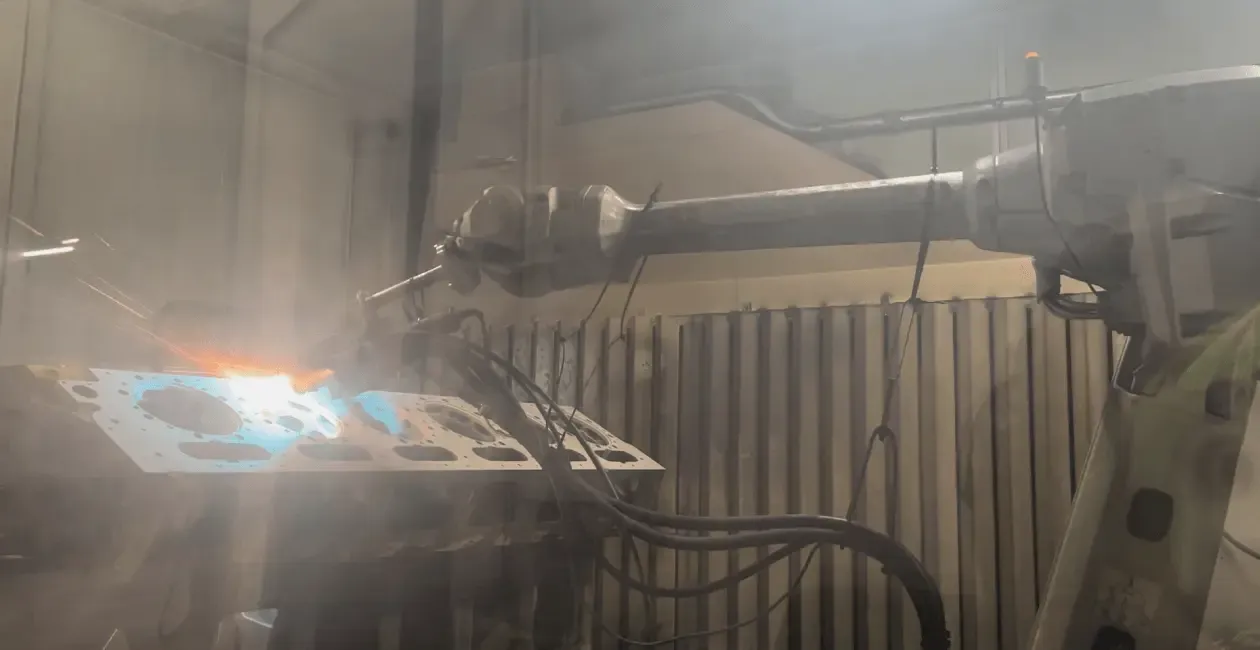
Thermal-spray programming is unusually unforgiving. Coverage uniformity depends on standoff, impingement angle, raster spacing, and TCP velocity all staying inside narrow process bands across the entire surface. Get any of them wrong and you don't find out until coating thickness measurements after the cycle.
Three programming approaches dominate the market. This paper compares them on the metrics that matter — coverage, consistency, and how long it takes to bring a new SKU online.
Teach pendant
A programmer drives the robot through every waypoint with a teach pendant, recording positions one at a time. For simple, flat or shallow-curvature parts this works. For thermal-spray it falls down quickly: thousands of waypoints are typical, blending radii need fine tuning, and the operator is guessing at angle-of-attack on every curve.
Onboarding time per SKU runs to days. Quality is operator-dependent: the same part programmed by two operators yields visibly different coating profiles.
Offline programming (OLP)
OLP uses CAD-aware software to plan the toolpath in a virtual cell, then transfers it to the real robot. For thermal spray this is a substantial upgrade over the teach pendant: standoff and angle can be enforced programmatically, raster patterns can be generated rather than taught, and simulation flags reach and singularity issues before execution.
The catch is the digital-twin tax. OLP requires an accurate model of the real cell — every fixture, every tool offset, every robot quirk — to within tight tolerances. Maintaining that model across cell changes is expensive, and the moment the model diverges from reality (worn fixturing, slightly different parts), the simulated toolpath lies and the real cell hits a wall.
OLP also assumes a CAD model of the part exists. For MRO and worn-component coating, it doesn't.
Augmentus
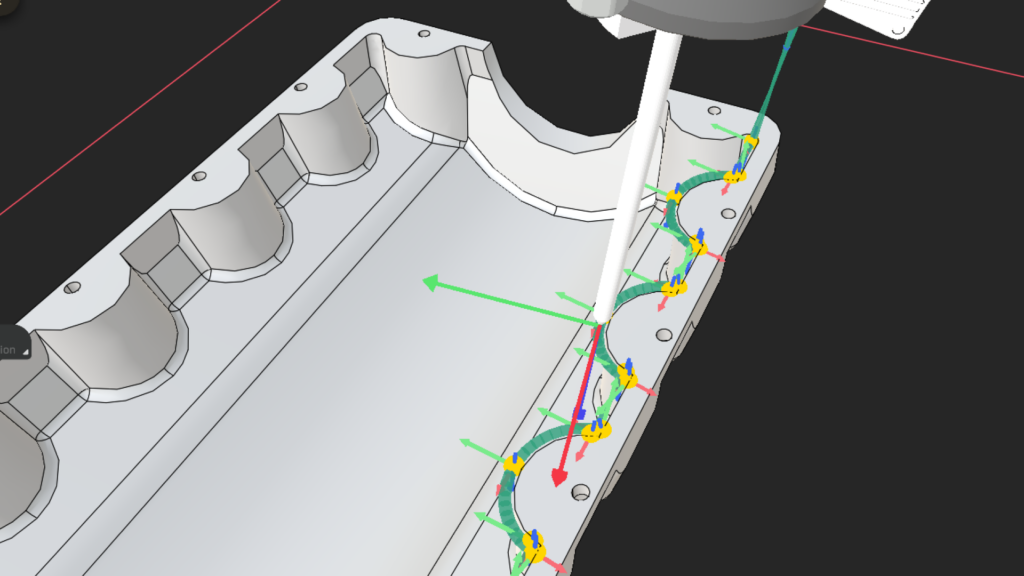
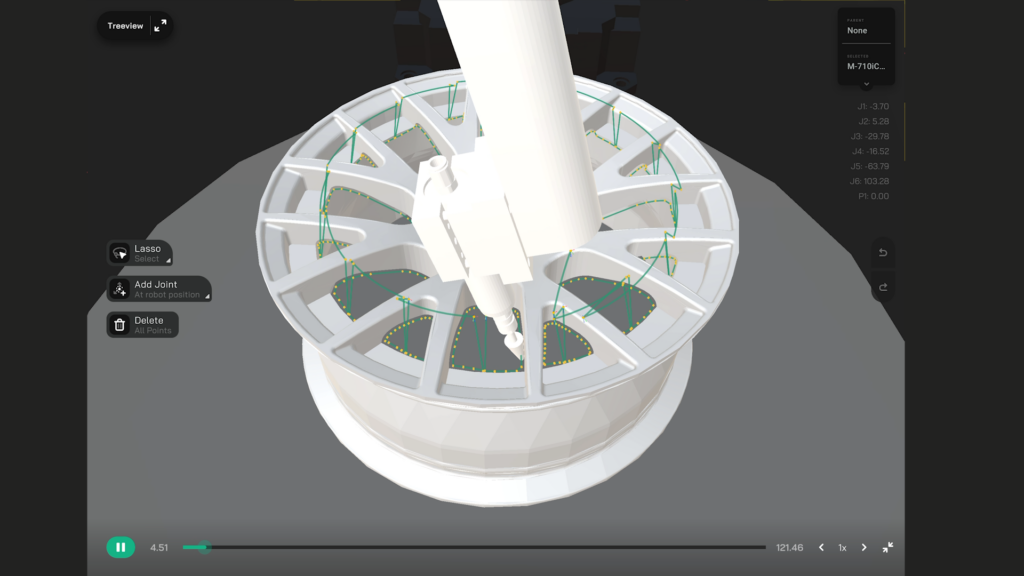
Augmentus' scan-driven workflow replaces both the CAD assumption and the programmed-toolpath artifact. An Augmentus Vision sensor reconstructs the actual part in front of the robot; AutoPath generates a coverage-aware toolpath against that reconstruction; the cell executes.
Three properties matter for thermal spray specifically: the toolpath respects the real geometry (not a CAD model that may have drifted), coverage uniformity is enforced at generation rather than hoped for after execution, and onboarding time drops from days to minutes.
For shops running aerospace MRO, gas-turbine refurbishment, or any high-mix coating workload, the scan-driven approach is the only one that doesn't break at the SKU-onboarding step.
If you'd like to evaluate the workflow on your thermal-spray parts, schedule a demo.