Programming thermal spray robots: teach pendant vs OLP vs Augmentus
Three approaches to programming thermal spray robots, and how they compare on aerospace and MRO work.

Thermal spray sits in a particularly demanding corner of robotic automation. The applications — aerospace blade coatings, turbine repair, MRO work — require tight control over standoff distance, traverse speed, and overlap. Small deviations show up as porosity, adhesion loss, or thickness inconsistency in the final coating.
The three approaches
Teach pendant
Operator drives the arm through every waypoint by hand and records each position. Works for simple parts, but thermal spray coverage typically needs dense waypoint patterns, and pendant teaching for complex blade or vane geometry becomes prohibitively slow.
Offline programming (OLP)
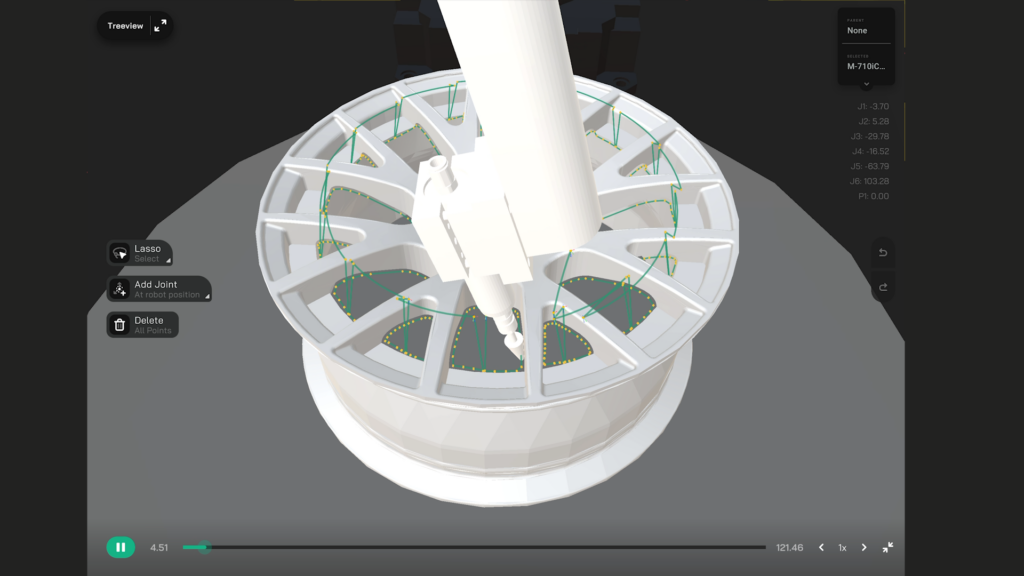
Programs are simulated in software like RobotStudio or Siemens Process Simulate, then deployed. The advantage is that complex paths can be optimised in simulation. The disadvantage is the digital-twin tax — the simulated cell must match the physical cell precisely, and any part variation from the CAD ideal degrades coating quality.
Augmentus (scan-to-path)
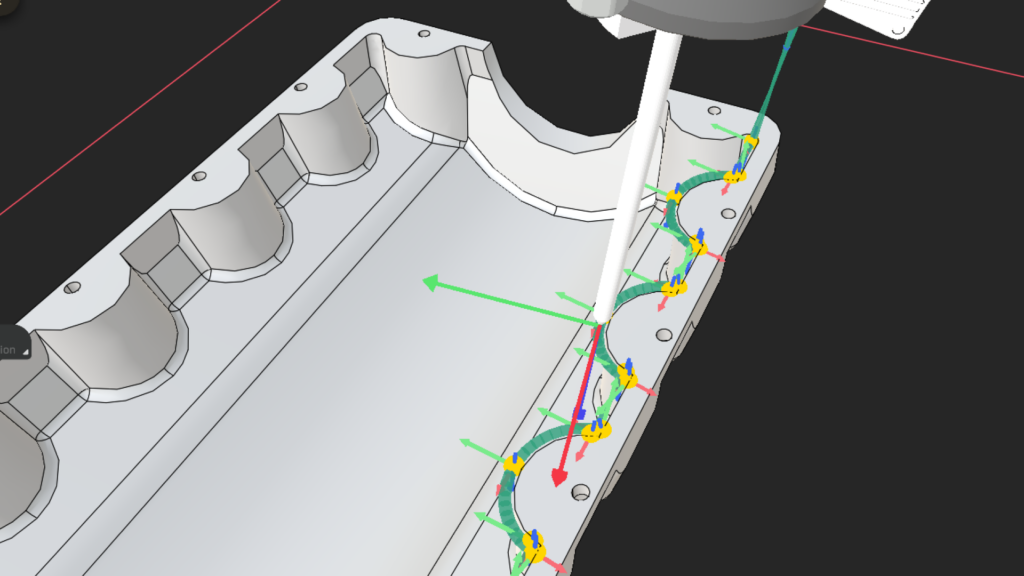
Augmentus' platform scans the actual part in place, generates the thermal spray path from the captured geometry, and deploys to the controller. Vision-guided adaptation re-anchors at execution time. The first part of a new variant takes the same setup effort as the hundredth of a familiar variant.
How they compare on MRO
For aerospace MRO specifically — where parts arrive worn, deformed, or post-repair — scan-to-path has a structural advantage. The robot follows the part it actually has, not the part it was supposed to have. OLP can compensate for some variation, but the digital twin can't see what the part really looks like today.