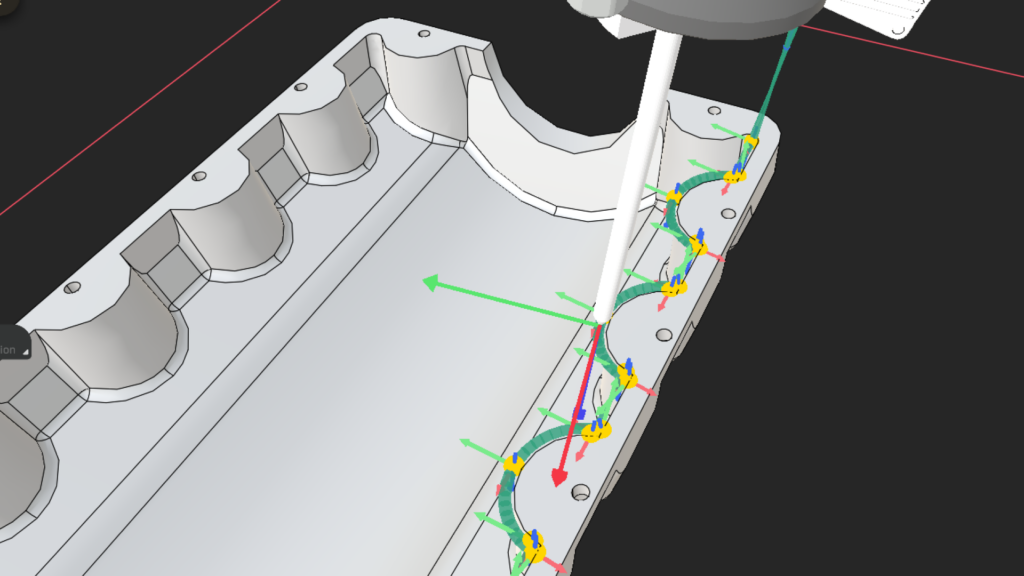
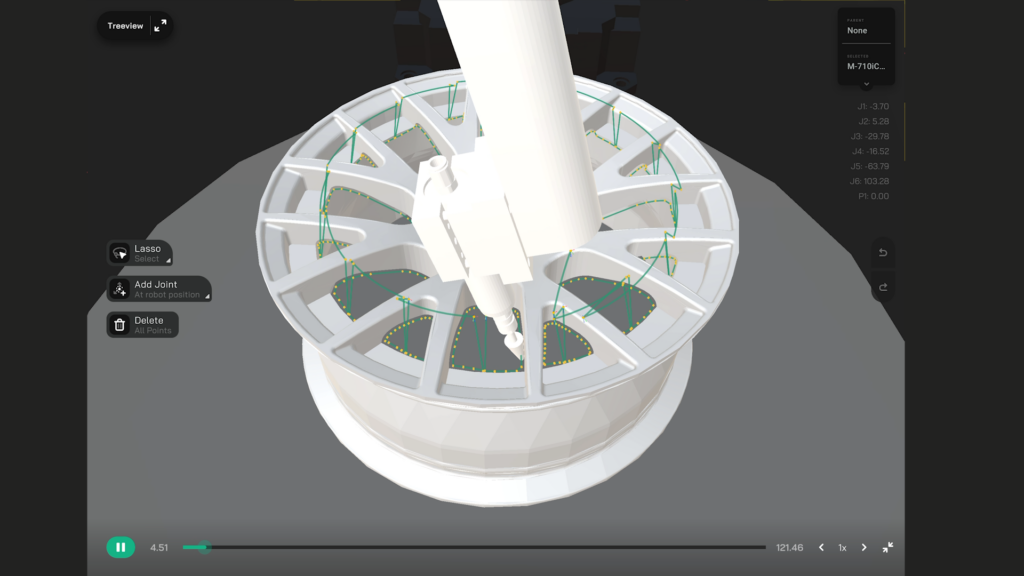
Mastering external axes — the hidden challenge in robot programming
Why coordinating turntables, linear rails, and tilters with a robot is the most under-counted programming problem in industrial automation.
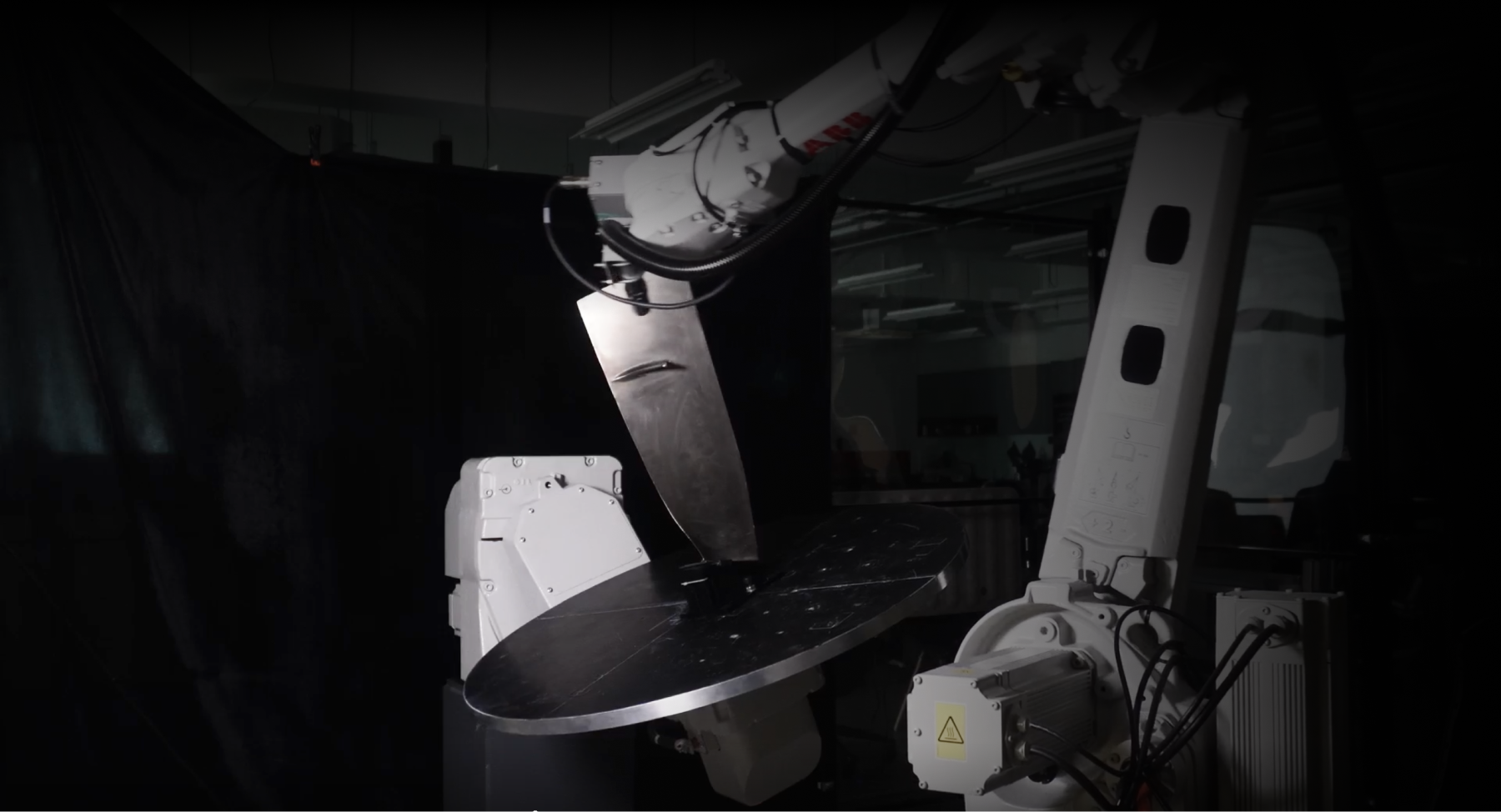
Add an external axis to a robot cell and you've added new capabilities — and a new programming problem. Every weld pose, every spray standoff, every sand-and-polish trajectory now has more than one solution, and choosing among them isn't something a teach pendant does well.
This paper walks through what makes external-axis programming hard and how an optimisation-first approach handles it.
The redundancy problem
A six-axis robot has six joints to position the tool wherever you want it. Add a turntable and now you have seven degrees of freedom for the same tool pose. Add a linear rail and you're at eight. The problem isn't that the cell can't reach a target — it usually can, in dozens of different ways. The problem is choosing the right way.
The choice matters because it determines whether the motion through a long toolpath stays smooth, whether singularities lurk along the way, whether joint limits get hit halfway through, and whether the cell's collisions clear or don't. Get the choice wrong on a single waypoint and you don't know until execution.
Why teach pendants fail at this
Teach pendants ask the operator to choose a configuration for each taught waypoint, then interpolate between waypoints in joint space. For a one-off part with a few dozen waypoints, this works. For a process toolpath with thousands of waypoints and external axes that need to coordinate smoothly with the robot, this becomes a guessing game where the operator is asked to predict, by eye, which joint configuration won't blow up over the next ten centimetres of motion.
The result is teach sessions that take days, with most of the time spent debugging configurations after a simulation run flags a singularity, a joint-limit hit, or a collision.
What an optimisation-first approach does differently
Augmentus' Path Optimizer treats the redundancy problem as an optimisation problem rather than a guessing problem. Given the full process toolpath, it searches for joint and external-axis trajectories that respect all kinematic constraints (limits, collisions, singularities) and minimise process objectives (cycle time, motion smoothness, TCP velocity adherence).
The output is a synchronised motion plan where the robot and external axes move together as a single coordinated system. The operator doesn't have to choose configurations because the optimiser has already evaluated them.
For high-mix shops with turntables, rails, or tilters in the cell, this is the unlock that makes scan-to-path work end-to-end. Without optimised external-axis coordination, the saved programming time on scan-driven toolpaths gets eaten by the time spent debugging configurations.
If you'd like to evaluate the optimiser on your cell, schedule a demo.