Closed-loop adaptive automation: a white paper
Why per-part variation breaks open-loop robotics, and how closed-loop sensing changes the economics of high-mix manufacturing.
The open-loop problem
Industrial robots have, until recently, been open-loop devices. A program describes a sequence of joint angles or Cartesian poses; the robot executes the sequence. The model of the world is captured at programming time — as fixtures, taught positions, or simulated CAD — and is assumed to remain true at every cycle thereafter.
This works beautifully for high-volume, low-variation work: automotive body welding, electronics assembly, parts handling. The world really does stay the same cycle after cycle. The robot's lack of perception is irrelevant.
It does not work for high-mix manufacturing — sandblasting, finishing, weld repair, MRO. In high-mix work, three things move that open-loop programming can't see:
- Part geometry varies — castings drift dimensionally, weldments come out slightly different every time, repair parts are entirely unique.
- Fixturing drifts — over the course of a shift, fixtures shift, parts settle, tooling wears.
- Process state changes — surface conditions, tool offset, environmental variables all evolve mid-cycle.
The result: open-loop programs produce inconsistent quality, require constant re-teaching, and demand expensive fixturing to compensate for what the robot can't perceive.
What "closed-loop" actually means
A closed-loop system senses, plans, and executes within the same control cycle. The world model is not frozen at programming time; it is updated continuously from sensor data. Three components matter:
Perception
The system captures what the part actually looks like — typically through 3D scanning, structured-light projection, or stereo vision. Modern systems can build a dense, calibrated mesh of an industrial part in tens of seconds.
The key technical challenge is registering the captured geometry into the robot's coordinate frame fast enough to be useful within the cycle. Augmentus does this through automated frame and tool calibration, executed without operator intervention.
Planning
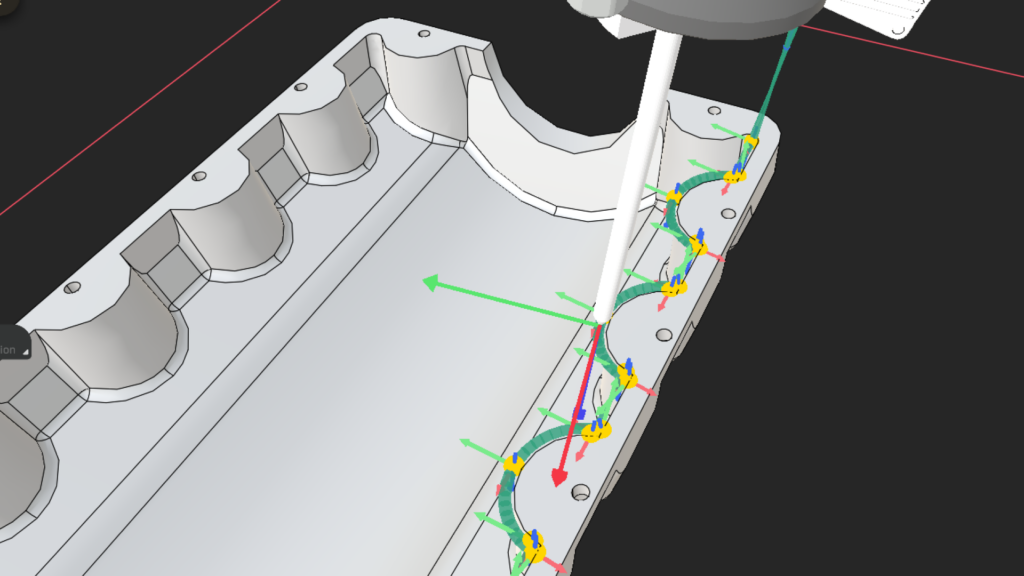
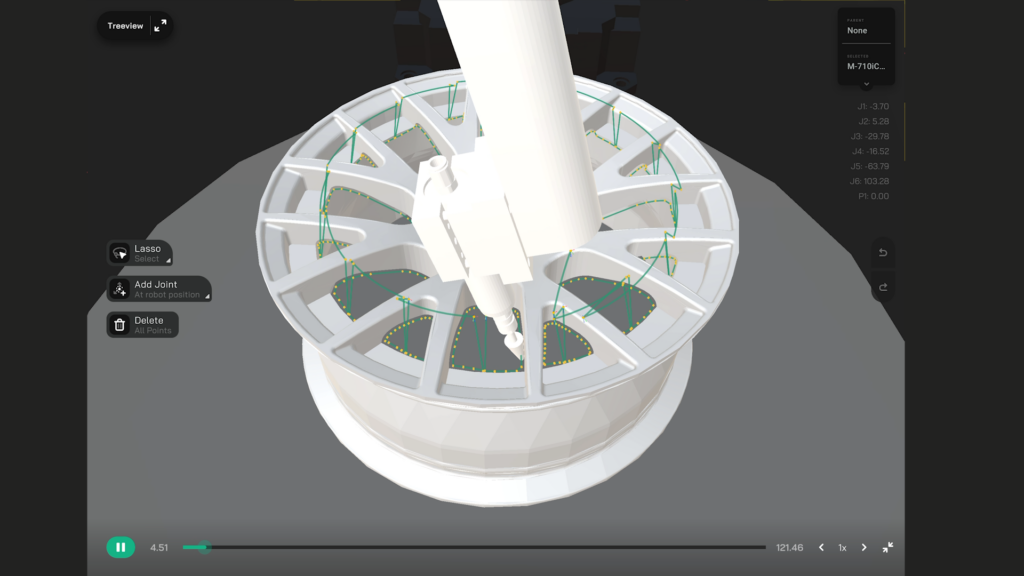
Given the captured geometry, the system generates the toolpath. This is where modern systems diverge most sharply from older offline-programming approaches: rather than treating the toolpath as a fixed artifact, it's regenerated from the current world state.
Path generation must respect kinematic constraints (joint limits, collision avoidance, singularity exclusion), process constraints (TCP velocity, standoff, angle of attack), and economic constraints (cycle time, blending radii, simulation accuracy).
Execution
During execution, the system continues to sense. If a defect appears, if the part shifts under load, if a tool wears faster than expected, the toolpath is adjusted in real time. This is the closed loop in closed-loop automation: a continuous feedback path from sensor to planner to motion.
Economics
The argument for closed-loop systems is, ultimately, economic. The unit economics of open-loop high-mix work are dominated by non-cycle time:
- Programming time per variant
- Re-teach time after fixture drift
- Inspection and rework after process drift
- Fixture investment to constrain variation
A 2024 industry survey of high-mix manufacturers found these non-cycle costs accounted for 40-60% of total automation cost. Closed-loop systems compress those costs by replacing labor-intensive programming with sensor-driven adaptation.
Where this is going
The next horizon for closed-loop systems is multi-modal perception: combining 3D geometry with material identification (spectroscopy, thermography), force-torque feedback, and acoustic emission. Each new modality extends the kinds of variation the system can see and adapt to.
For manufacturers evaluating closed-loop automation today, the practical question isn't whether the technology works — it does — but how quickly the unit economics shift in their specific cell. We'd love to help you work that math out.