AutoPath: automating deburring without manual teach pendant programming
How Augmentus' AutoPath generates collision-free deburring trajectories for complex parts.

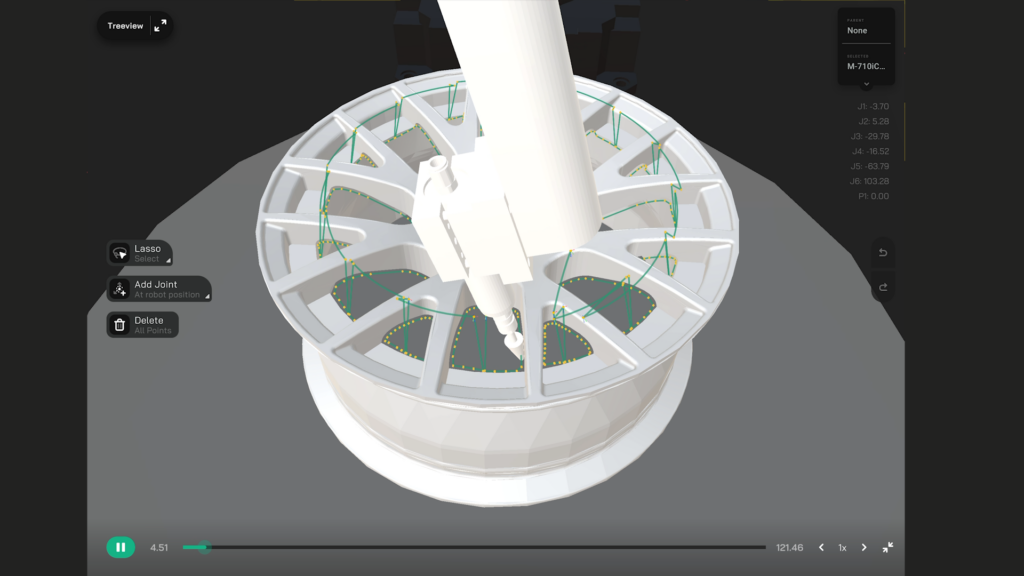
Deburring is one of the harder things to automate well. The parts that benefit most — castings, machined wheel rims, weldments — have geometry that varies subtly from piece to piece. Teaching a deburring path by pendant takes hours, and the moment the next part shifts on the fixture, it has to be re-taught.
What AutoPath does
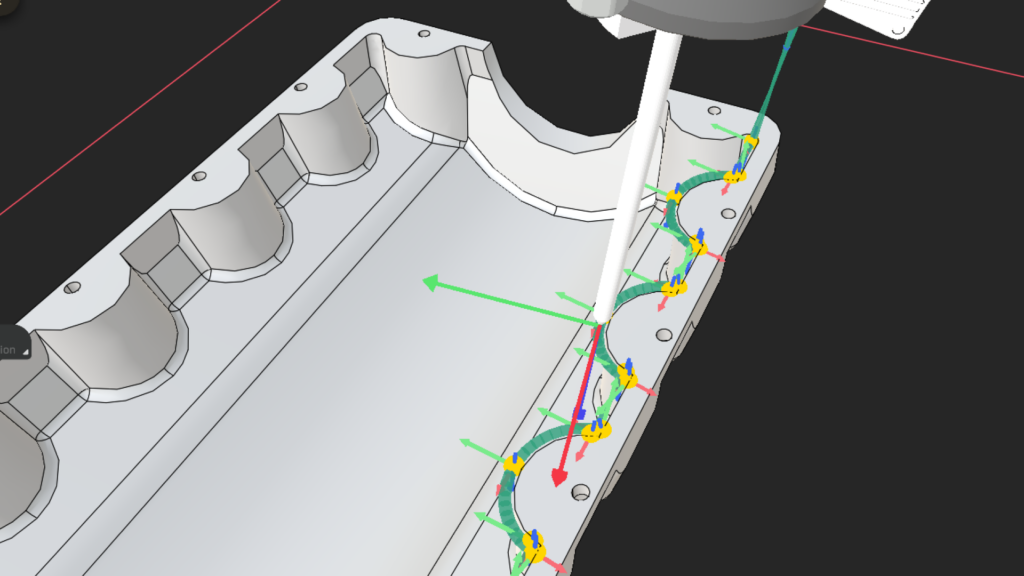
AutoPath is the Augmentus tool that generates deburring trajectories without manual teaching. The workflow is straightforward:
- Load a CAD file or scan of the part into the simulation environment.
- Identify the edges and faces that need deburring.
- Choose the process parameters — tool, feed rate, contact pressure.
- Let AutoPath generate the trajectory, then preview it in simulation.
The output is a collision-free, kinematically valid program ready to deploy to the controller. Joint singularities are detected and routed around automatically.
Why this matters on the floor
The hard part of deburring isn't moving the robot — it's spending the time to find every edge that needs work. AutoPath collapses that step. Combined with vision-guided adaptation at execution time, the system can also compensate for parts that arrive on the fixture in slightly different positions every time.
The net effect: deburring becomes a load-and-go process. The cell handles new part variants without engineer involvement.