Four essential methods for programming ABB robots
A practical look at the programming approaches available to operators of ABB industrial robots.

ABB robots run nearly every kind of factory cell you can imagine — welding, assembly, finishing, palletising. The question for operators is rarely whether to deploy an ABB arm; it's how to program it efficiently for the work in front of you.
The four common approaches
Most ABB robots are programmed in RAPID, the controller's native language. From there, four delivery methods dominate the floor:
- Teach pendant — the operator drives the arm through every waypoint by hand and records each position. Reliable, but slow, and brittle when parts change.
- Manual RAPID code — engineers write programs directly in RAPID. Maximum control, but it demands deep ABB-specific expertise.
- Offline programming (OLP) — programs are simulated in software like RobotStudio, then deployed. Good for cycle-time optimisation, but the digital twin must mirror reality precisely.
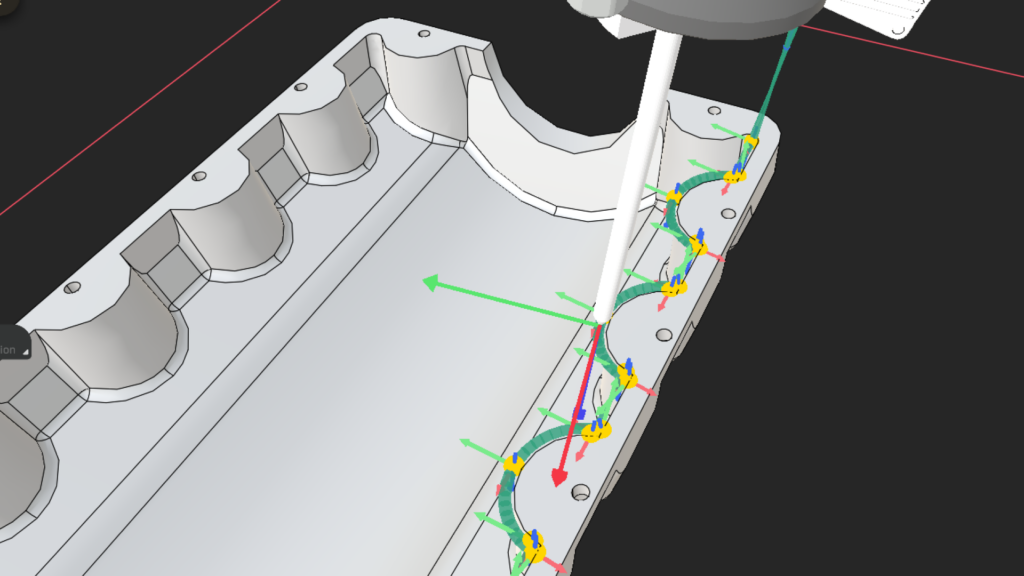
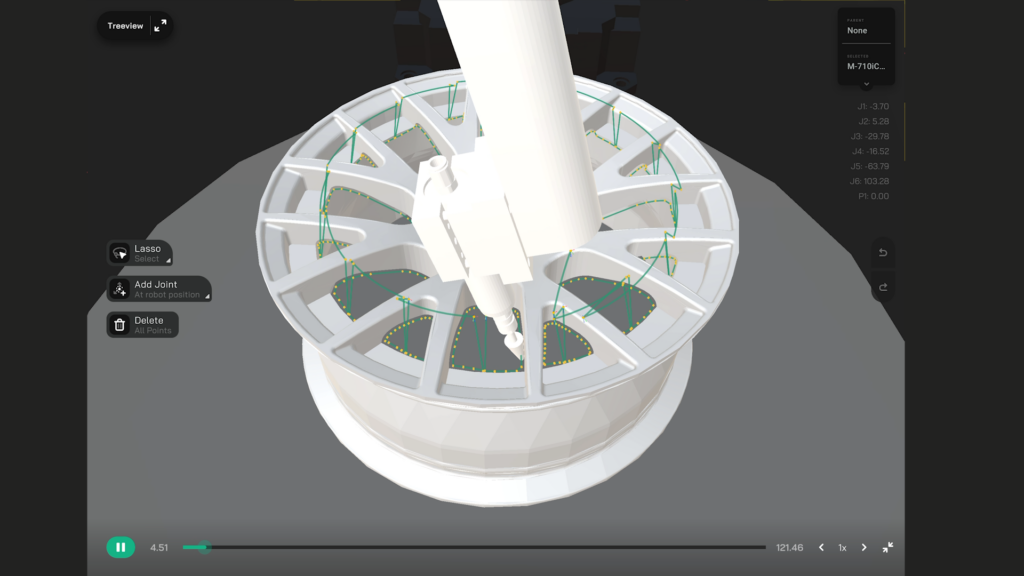
- No-code generation — modern platforms generate the RAPID program automatically from CAD or a 3D scan of the real part.
Where no-code changes the math
Pendant teaching is fine for stable, high-volume work. The trade-off appears the moment your parts or fixtures start to drift. Each variant becomes a new programming job, and the cost of that recurring effort compounds quickly across the year.
A no-code workflow replaces the human-in-the-loop programming step. You scan the actual part, choose the process, and the system generates a collision-free RAPID program. The first part takes the same time as the thousandth.