3D scanning with industrial robots: maximising part-reconstruction accuracy
Linear rail, rotary, and multi-angle scanning strategies — when each wins and how to combine them.
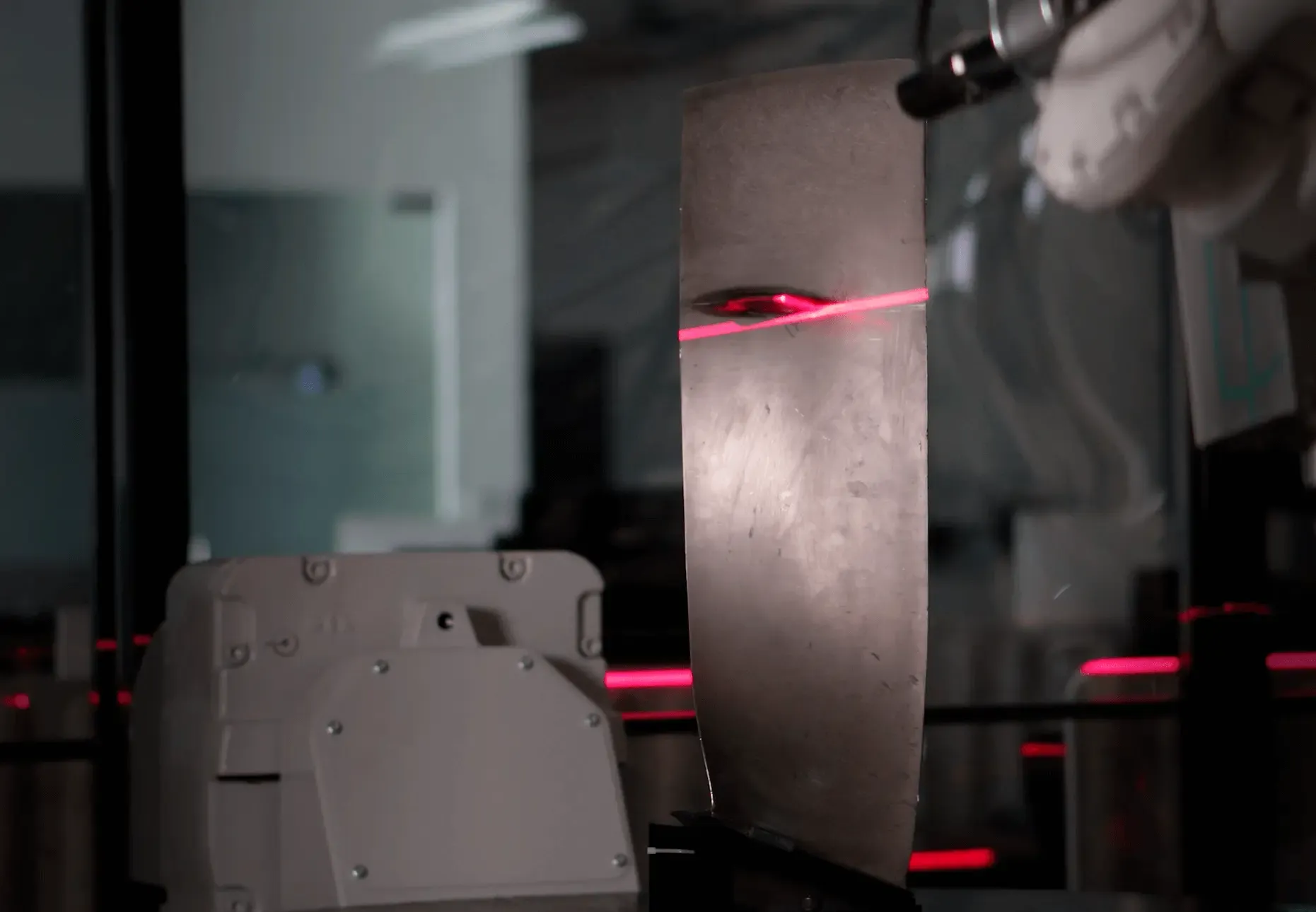
Every scan-driven robotic cell rests on one assumption: that the 3D mesh the system uses to plan the toolpath is metrically accurate. Get the scan wrong and every downstream step — path generation, collision avoidance, deviation correction — is wrong by the same margin.
This paper walks through three scanning strategies routinely deployed on industrial robots and where each one wins.
Linear-rail scanning
The robot — or the sensor mounted on a rail — translates linearly across the part while a laser profiler or structured-light scanner captures the surface. Linear rails work well for long, prismatic parts: extrusions, large flat panels, pipe sections, structural members.
The main failure mode is occlusion. Anything that sits inside an undercut, a deep pocket, or behind a feature won't be captured by a single linear pass. For these parts, you either accept the gap or supplement the scan with another strategy.
Rotary scanning
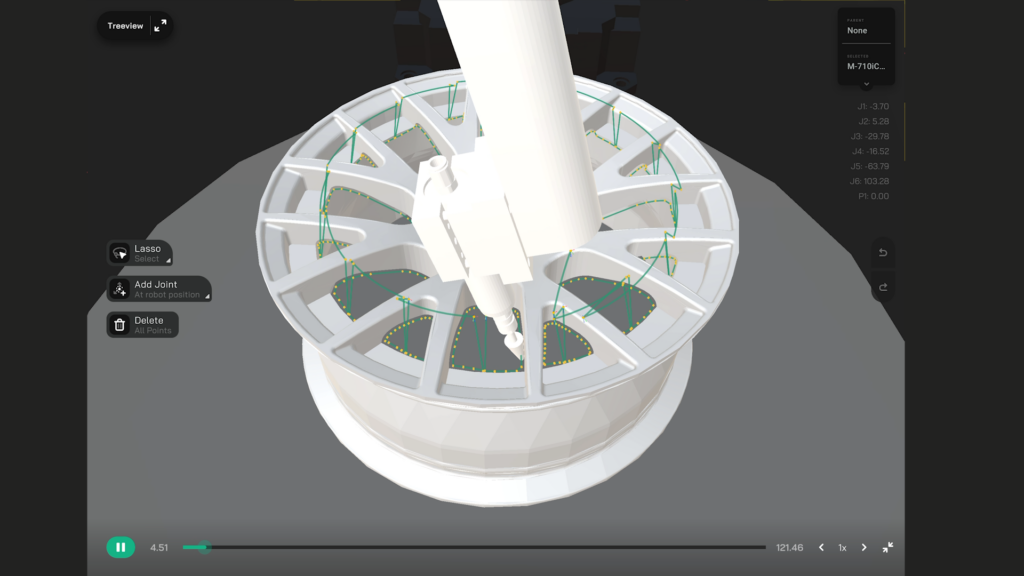
The part rotates on a turntable while the sensor scans from a fixed (or articulated) position. Rotary works well for revolved geometries: turbine blades on a peening turntable, valve bodies, cylindrical castings.
The failure mode mirrors linear: anything not visible to the sensor across the rotation stays uncaptured. Conical or asymmetric features need additional pose changes.
Multi-angle scanning
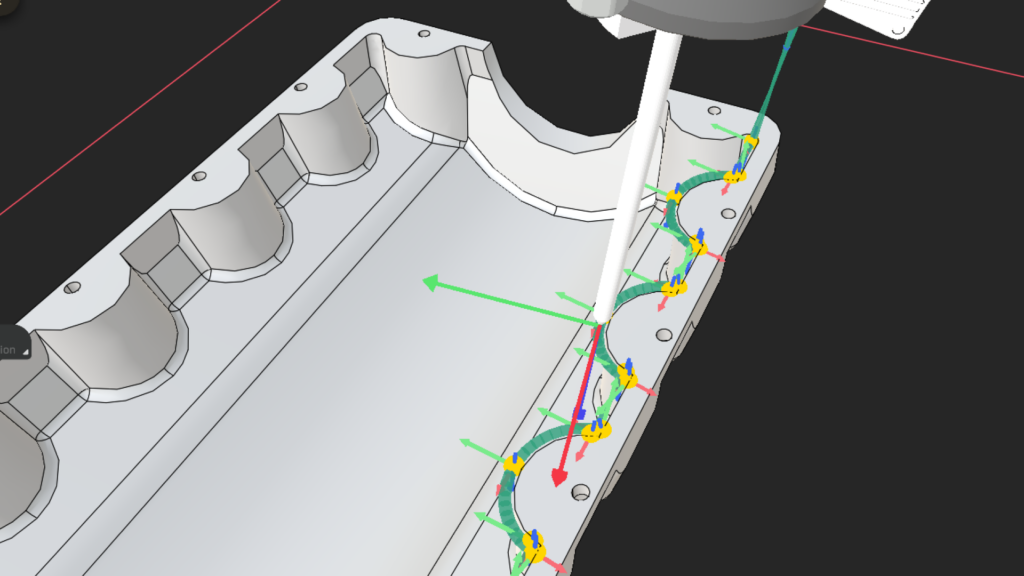
The robot moves the sensor through a sequence of poses around the part, stitching captures into a single coherent mesh. Multi-angle is the right answer for complex, single-piece parts: weldments, freeform machined components, castings with deep undercuts.
It's also the slowest of the three. Stitching adds processing time, and multi-pose calibration adds setup time.
Combining strategies
The pragmatic answer for most production cells is to combine strategies. A typical hybrid recipe: rotary capture of the body of a part, multi-angle supplemental scans for the features that the rotation can't reach, and linear-rail extension for long appendages.
Augmentus' AutoScan workflow supports all three strategies and the combinations between them, so the strategy decision is per-part rather than per-cell.
If you'd like help picking the right scanning strategy for your geometry, schedule a demo.