3 ways to program industrial and collaborative robots
Teach pendant, offline programming, and no-code generation — how each approach trades cost, time, and flexibility.
Industrial and collaborative robots are everywhere, but the way we program them has barely changed in twenty years. Three approaches dominate the market — and each one trades off cost, setup time, and the kind of work it can handle. This piece walks through each, where they win, and where they fall apart for high-mix manufacturing.
Teach pendant programming
The classic approach: an operator with a teach pendant moves the robot through every waypoint on a part, recording positions one at a time. It's the default for new cells because it requires almost no infrastructure — just the robot, the pendant, and someone who knows the pendant's quirks.
It works well when you have high volumes, low part variation, and consistent fixtures. Once a teach is in place, the program runs forever. But the second a part changes — even a small dimensional drift — someone needs to re-teach. On a high-mix line, that re-teach is the bottleneck.
Offline programming (OLP)
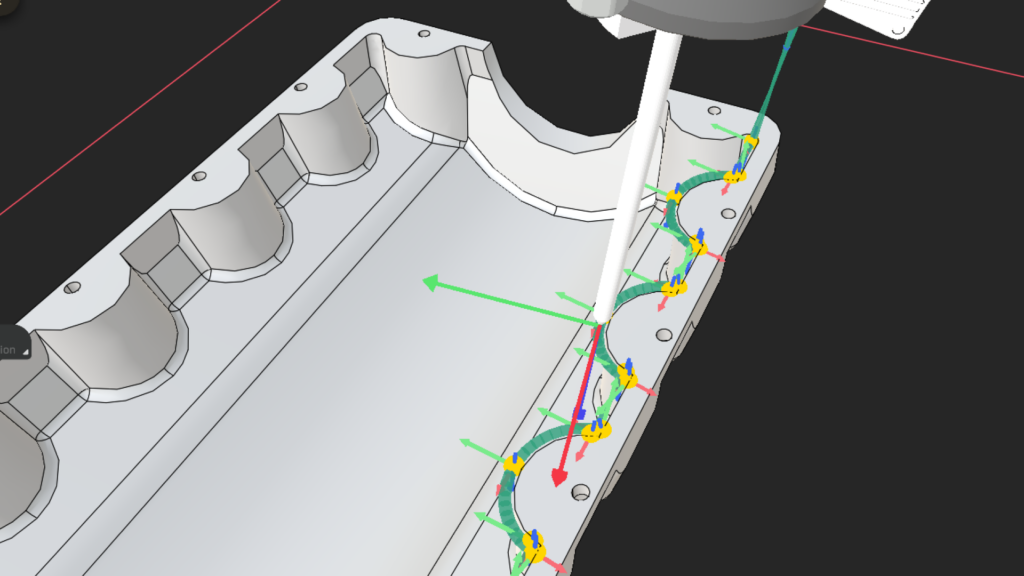
Offline programming uses CAD-aware software to plan the entire program in a virtual cell. The advantage is huge: you can simulate cycle time, detect collisions, and check reach without taking the robot offline.
The trade-off is the digital-twin tax. The simulated cell must match reality to within tight tolerances — every fixture, every tool offset, every robot quirk. Setting that up is expensive, and the moment something drifts (worn fixturing, slightly different parts), the simulation lies and the real cell hits a wall.
No-code generation
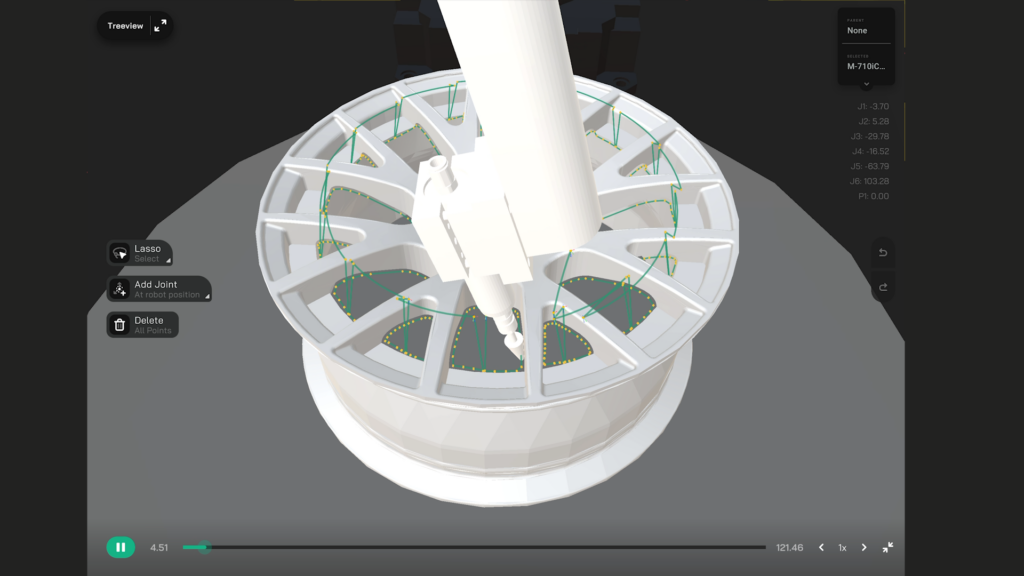
The newest category — and what Augmentus does — collapses both. A 3D scanner (or CAD) describes the real part. A no-code recipe describes the process. The system generates the toolpath from geometry, simulates it, and deploys it. When the part changes, the system re-scans and re-generates rather than asking a human to re-teach.
Which fits your shop?
A rough heuristic:
- High volume, identical parts, stable fixtures → teach pendant is fine. Don't over-engineer.
- Long-running family of similar parts, expensive cell → offline programming pays off. The simulation investment amortises across years of cycles.
- High mix, frequent changeovers, parts that drift → no-code generation. The cost of re-teaching every variant outweighs the cost of the platform.
If you're not sure which bucket your line falls into, the question to ask is: what fraction of our shop time is spent programming, re-teaching, and troubleshooting? If the answer is more than 20%, you're a candidate for no-code generation.